Take something with you · Thesis 01
The decision doesn't happen on your website anymore.
For twenty years, being findable meant having an address. Then the addresses stopped being where people go.

Four people are deciding where to eat on Friday. Watch what they actually do. One of them opens a map and pinches around the neighborhood. One scrolls a feed until something stops the thumb. One types a question into an assistant — somewhere with a patio, six of us, one vegetarian — and reads the three names it hands back. One asks the group chat, which is really asking a friend who ate somewhere good last month.
Nobody opens a restaurant's website. Not yet. The site gets opened eleven minutes later, after the decision is made, by whoever has to find the address.
This is the part of the shift that gets missed, because it doesn't look like a loss. Traffic still arrives. The site still gets visits. But the job that site is doing has quietly changed underneath it — from the place where people are convinced to the place where they confirm. It stopped being the storefront. It became the receipt.
The web used to be made of places you went
The early internet was built on a spatial metaphor and the metaphor was accurate. Sites were destinations. A URL was an address. You navigated — the word we still use — from one place to another, and the whole apparatus of being findable was built around getting someone to travel to your address instead of somebody else's. Search engines were directories of doors. Ranking mattered because the human being did the opening.
Under those rules, one good website was a coherent strategy. It was the only place your business existed, and it was where the deciding happened, so you put everything into it: the photos, the menu, the story, the phone number. Build the destination well and the traffic arrives and the decision gets made in a room you control.
Every part of that sentence has come apart.
The surfaces stopped sending people onward
What changed isn't that people got lazier or that attention got shorter. What changed is that the surfaces where attention pools got very good at answering, and stopped needing to forward anyone anywhere.
A search result now shows hours, photos, reviews, a booking button, and a summarized answer, without a click. A map holds the whole business — the pictures, the busy times, the menu someone else uploaded, the review from March. A feed is discovery that never asks you to leave; you were not looking for dinner, and now you are. An assistant reads on your behalf and comes back with a recommendation, having visited nothing you'd recognize as a visit.
The click-through was never the point. It was a symptom of a web that couldn't answer yet. Now it can.
So the deciding moved. It moved to a dozen surfaces that hold their audiences, and it is happening on all of them right now, tonight, whether or not anyone has updated anything in a year.

Presence became plural
Here is the asymmetry that follows, and it is arithmetic more than it is marketing. The deciding is distributed across many surfaces. Most independent restaurants are present on one, in any meaningful sense — the site — and represented on the others by whatever accumulated there without them. A map listing built from a phone book. Photos taken by guests in 2019, when the room had different chairs. A menu PDF two price changes out of date. A profile someone set up before the last chef.
None of that is neglect. It's the natural result of building for the old model: you were told to build a destination, you built one, and it is genuinely good. The problem is that the destination is now the last stop rather than the first, and the first stops are running on a version of you that you didn't write and can't see.
Being present in one place used to be sufficient because one place was where everything happened. It isn't insufficient because the number went up. It's insufficient because the number went to zero at the place you invested in and moved elsewhere.
The thing that actually broke: presence is a job now, not a project
There's a deeper change underneath the distribution one, and it's the one that decides who can keep up.
A website is a project. It has a start, a middle, a launch, and an invoice. When it's done, it's done, and it keeps working for years, which is exactly why the model was so appealing to businesses that had no time. You bought reach once.
Every surface that replaced it runs on the opposite logic. A feed asks what you did today. A map ranks currency and freshness. Reviews arrive on their own schedule and need answering this week, not next quarter. Search now re-reads what changed. The assistant that recommends you is reading whatever is true right now. None of these are things you can finish. They're things you feed, or they decay — and decay is not neutral, because the surfaces are comparative. Everything on them is being ranked against the place down the street that posted on Tuesday.
The web moved from things you build to things you feed. Restaurants are staffed for the first one.
That's the real gap, and it isn't a skills gap or a caring gap. A restaurant with fourteen employees and a four-point margin has nobody whose job is to keep eleven surfaces current, and the person who would do it is the owner, who is at the pass. So the surfaces go stale — not because the restaurant is stale. The room was full and loud on Friday. It just didn't get transmitted anywhere.
The honest counterpoint
None of this argues for being everywhere. Being present badly on eleven surfaces is worse than being present well on three — a dead profile is a stronger signal than no profile, and it's the wrong signal. Presence being plural doesn't mean posting more. It means the same true thing about tonight showing up in each place the decision is actually being made. Most restaurants would be better served by three surfaces kept honestly current than by a calendar of content nobody has time to mean.
What this means if you run a restaurant
The practical form of all this is a question that's uncomfortable to answer precisely: where did my last ten guests actually decide?
Most owners have a story about this, and the story is usually wrong in a specific direction — it over-credits the surfaces they can see (the website, the mailing list) and under-credits the ones they can't (a map result, a fifteen-second clip, a friend's recommendation that was itself downstream of a clip). The gap between the story and the answer is where the budget is misallocated, and it costs nothing to close except the nerve to ask.
So ask. Not with a survey — at the table, on the way out, in the ordinary way you already ask people how everything was.
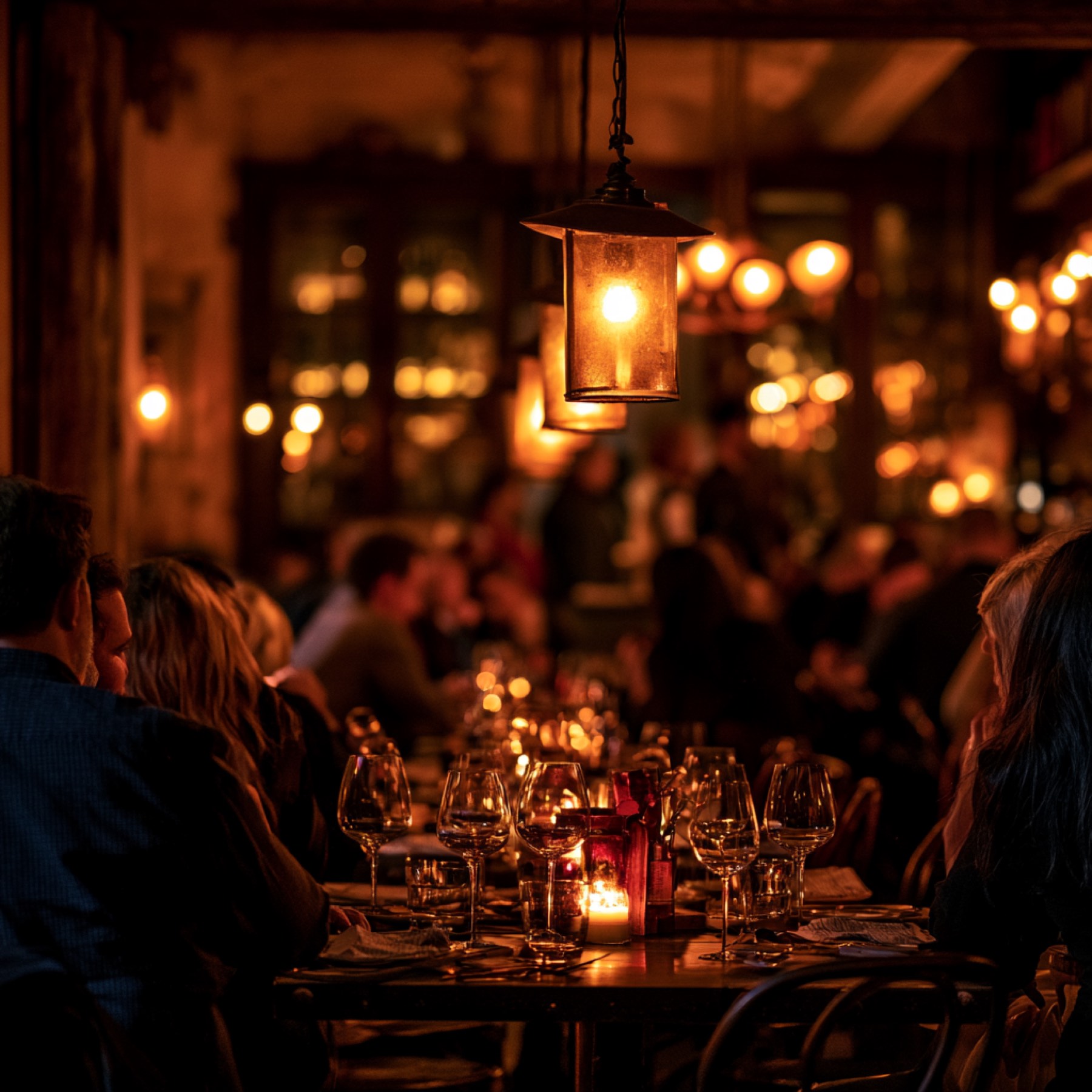
Because here's what makes this worth the trouble. The room at eight on a Friday — full, loud, warm, particular, thirty people who chose to be there — is the most persuasive asset a restaurant will ever have. It is better than any advertisement anyone could write for it. And the version of that room a stranger meets at midnight is a PDF menu and a photo of the empty dining room taken before opening.
Guests don't go missing at the door. They go missing at the decision, on a surface nobody in the building was watching, several hours before anyone would have had the chance to be hospitable to them.
Take something with you
Trace your last ten guests
This takes one service and a pen. It's the cheapest research a restaurant can run, and it usually overturns the house theory about where guests come from.
- Ask ten tables one question. "How'd you hear about us?" — asked the way you'd ask how the food was, not as a survey. Ten is enough. Twenty is better. Do it on a normal night, not a busy one.
- Write the surface, not the sentiment. Not "word of mouth" — whose mouth, and where did they see it. Not "online" — the map, the feed, the assistant, the search, the friend who saw the clip. Push one question further than feels natural.
- Mark where the deciding happened. For each answer, note the moment they chose you, and separately the moment they opened your website. They're rarely the same moment, and the order tells you what your site is actually for.
- Count how many of those surfaces you're actually present on. Present meaning: something true about this month is visible there. Not "we have an account." Most restaurants score one or two out of the surfaces their own guests just named.
- Look at what's on the ones you don't run. Open your map listing and your profiles as a stranger, on a phone, at midnight. Whatever's there is your front door, whether you built it or not.
The number that matters isn't the total. It's the gap between the surfaces guests named and the surfaces you feed. That gap is the whole strategy, and you now have it on paper.
Written by the team at Amplified AI, an Ide8 company. We build Amp, an AI Revenue Manager for restaurants, so we plainly have a view on this — which is why the argument above is made without any numbers we can't source, and why it's about the shift rather than about us.